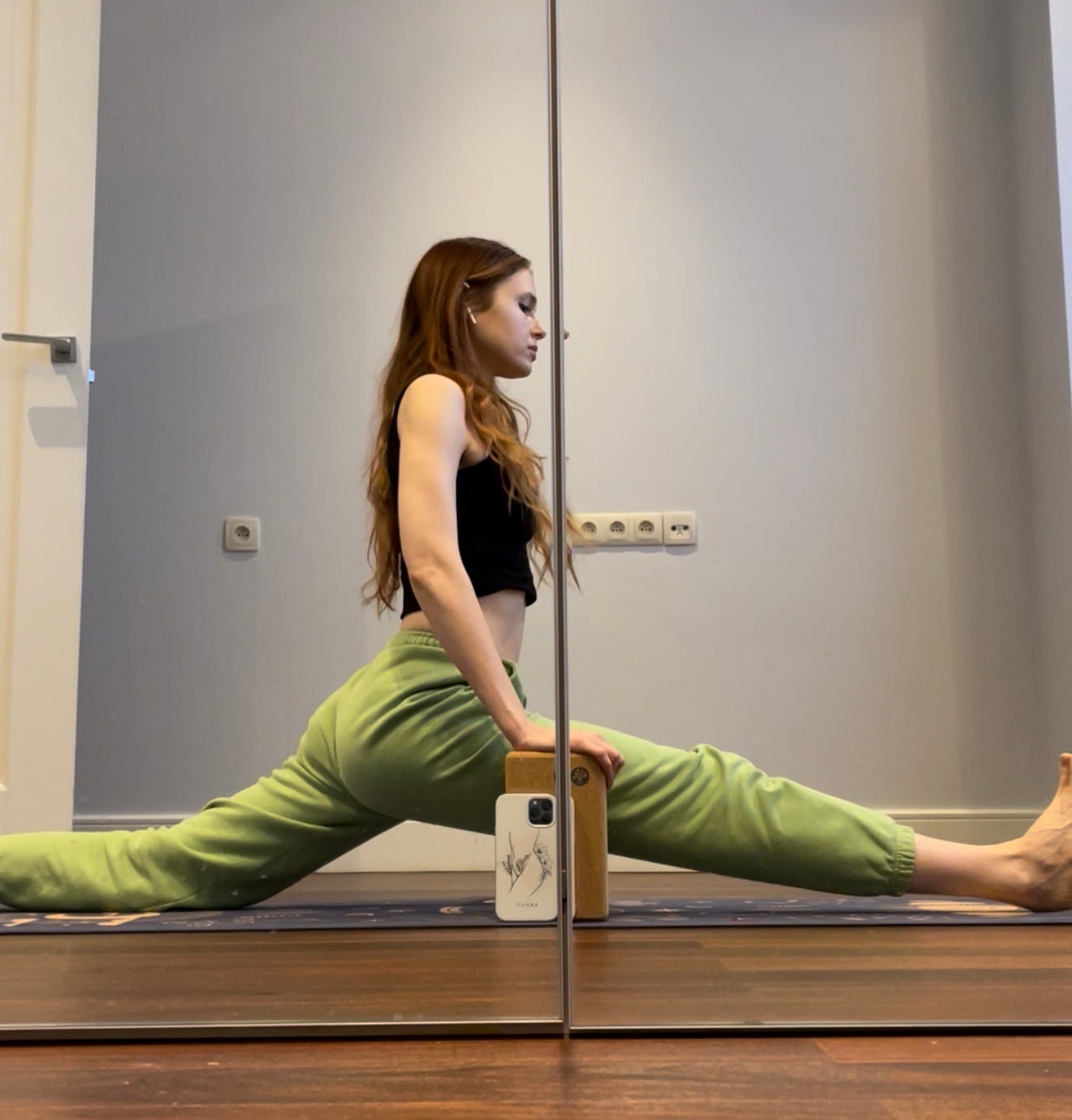
When the journey matters more than the goal: splits in yoga
✦ 2 min
A full split looks impressive. For some it is demanding. For many people it becomes a symbol of flexibility, of being advanced, of "progress" in practice.
But is that really the point?
Hanumanasana shows beautifully that the most important part of practice happens before we reach the full pose.
You don't have to touch the floor
In practice it's easy to get lost and start treating an asana like a shape that has to be achieved.
"A bit lower. A few more centimetres. Maybe tomorrow I'll manage to straighten my legs completely."
Meanwhile, Hanumanasana doesn't have to look like a perfect split to be a valuable practice.
You can use blocks under your hands. You can keep your hips higher. You can slightly bend the front leg. You can work in Ardha Hanumanasana, the half split.
A pose doesn't become any less "yogic" just because it doesn't look like the photo.
Quite the opposite. It is in this version that you may have more space to notice your breath, the tension that arises and your body's response.
If you try to go lower at all costs, you may start ignoring the signals your body sends, and then the road to injury gets shorter.
And a yoga practice can, and should, look completely different.
Instead of asking:
"How deep can I go?"
try asking yourself during practice:
"How does my body feel right now? Can I breathe freely and deeply? What emotions have come up?"
Yoga is not a flexibility test
Two people can practise the same asana and need completely different versions of it.
One person can come close to the floor in the splits without any trouble. Another may need blocks and put the full split off until later, without treating it as a goal.
That doesn't mean one of them "is better at Yoga".
Each of our bodies has a different build, different ranges and different held emotions.
That's why full Hanumanasana is not a measure of how advanced you are. One day you may naturally find yourself much lower than before, and treat it more as information than as a reward.
Try this version
Next time you practise Hanumanasana, don't start by trying to reach the full pose.
Start with a few calm breaths.
Place your hands on blocks. Find the height at which you can stay without fighting your body.
Notice:
- where tension appears,
- whether you're holding your breath,
- whether you're trying to "push through" your range,
- whether you can stay in the pose without constantly striving for more, and trust the process.
- what emotions come up
And let that be enough.
Hanumanasana can look like a pose that has to be conquered.
But perhaps the way to get to know yourself will be the journey itself. Observe:
- Your level of patience
- Your ambitions
- The way you react when something doesn't come right away.
- Your relationship with listening to your body
Yoga begins when you start to be truly present in what is happening now.
And maybe that's exactly why the most valuable version of Hanumanasana doesn't have to be the deepest one at all? What do you think? The splits are just one example, but maybe some other pose is "keeping you up at night", and you can apply the advice above to it.